
Concrete Inertia Bases
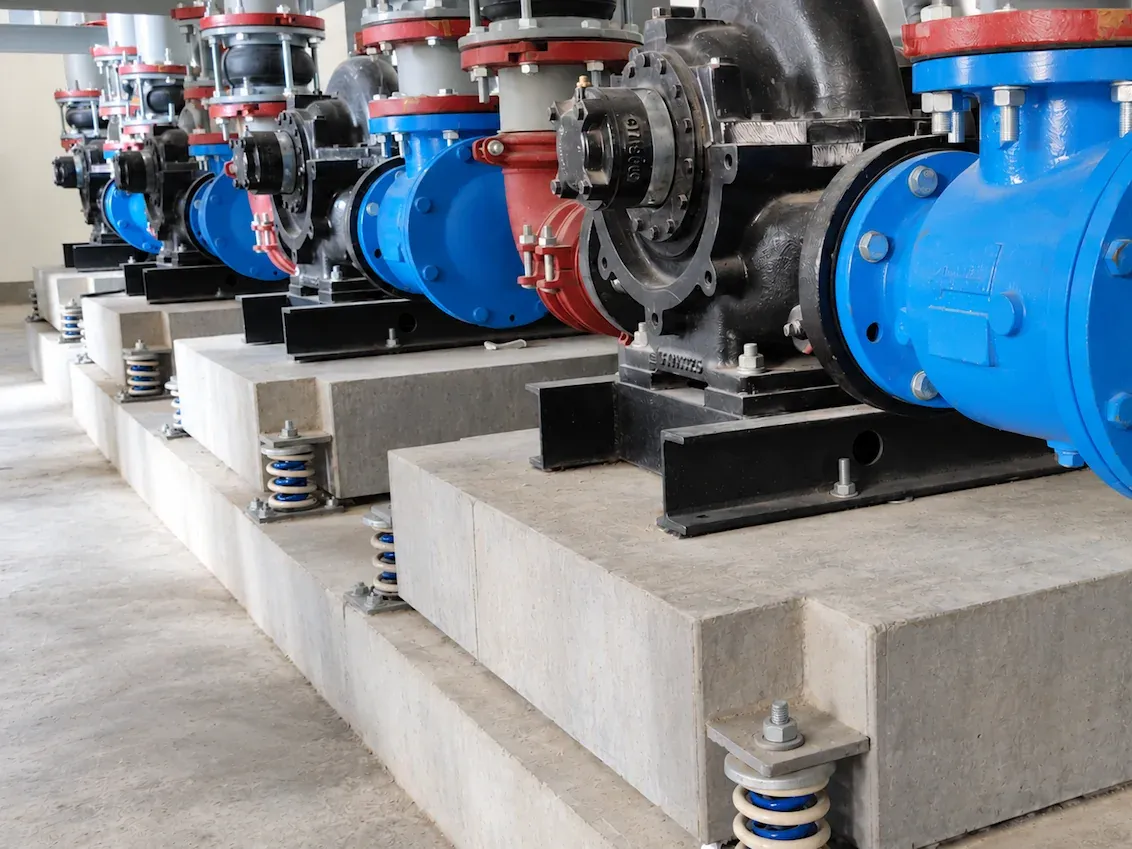
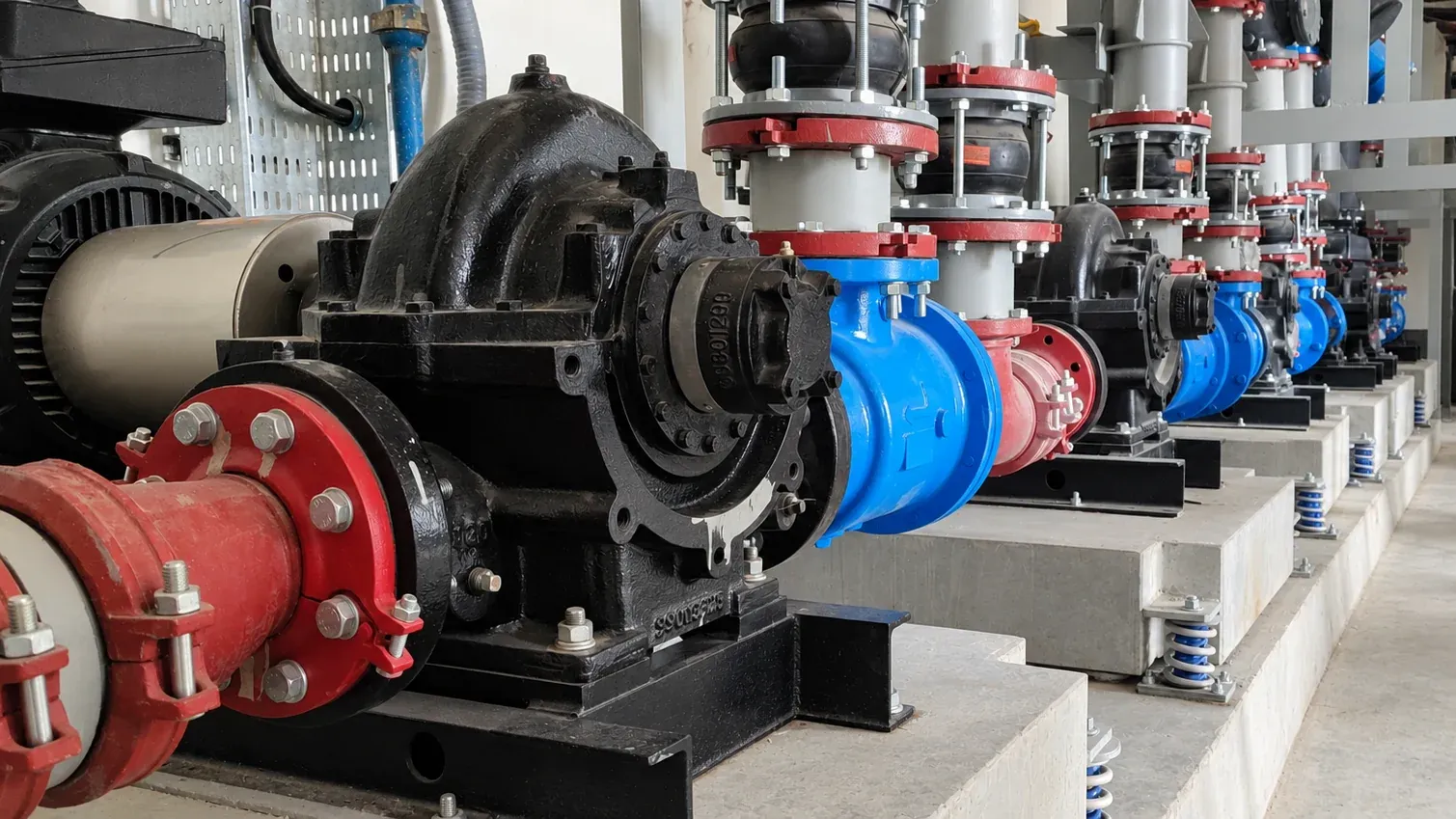
A steel frame filled with concrete that adds mass under pumps, compressors and fans. The extra mass lowers the centre of gravity, calms start-up torque and rocking, and lets the isolators beneath it do their job. We design the base and the isolators as one system.
The system
Not a slab, a system
An inertia base only works with the isolators under it. Mass, frame, brackets and springs are sized together, for the equipment, its running speed and the floor it stands on.
- EquipmentPump and motor fixed to the base, so they move as one mass.
- Concrete fillThe mass: at least 1.5 times the equipment, ideally 3 times.
- Steel perimeter and rebarChannel frame with reinforcing bars to our template; depth at least 1/12 of the longest side, never under 150 mm.
- Isolator bracketsSet at the height that brings the centre of gravity down and keeps the base level.
- Spring isolatorsOpen springs in most plant rooms; 25 or 50 mm deflection as standard.
- Seismic restraintIn seismic zones, snubbers beside the base or seismic isolators in place of open springs.
The range
Welded, modular or steel only
Two inertia bases filled with concrete on site, and a steel base for equipment that needs a rigid frame rather than mass. Each is sized to the equipment and supplied with the isolators that go under it.
 AIB-M
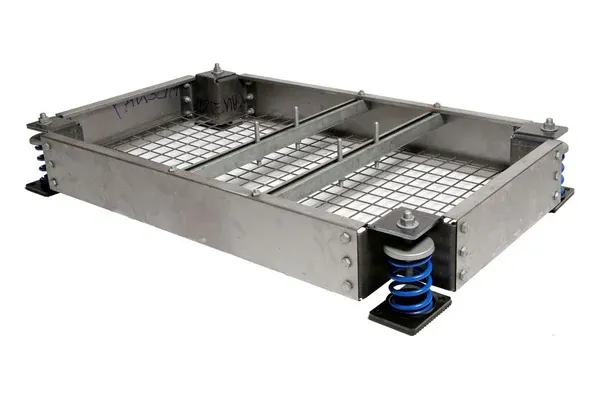
Modular Inertia Base
Perimeter channels and brackets that bolt together on site, with no welding.
150 or 200 mm deep · rectangular, L or T
Ask us for a selection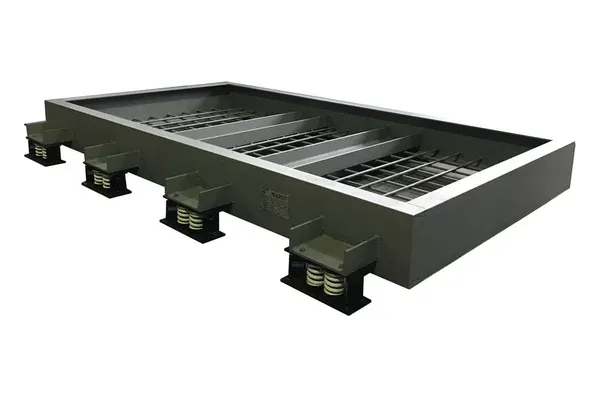 AIB-W
Welded Inertia Base
Welded channel perimeter with isolator brackets, filled with concrete on site.
150 to 300 mm deep · rectangular, L or T
Ask us for a selection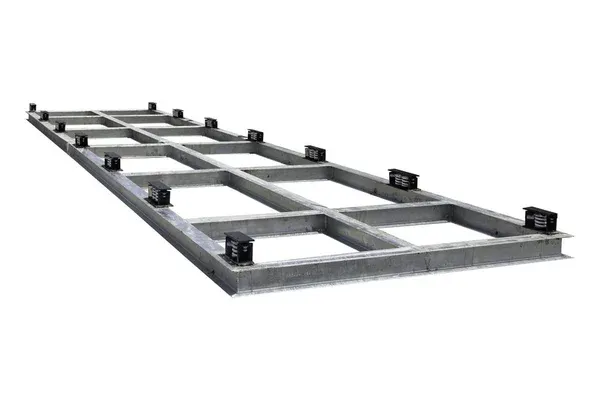 AB-W
Structural Steel Base
A rigid steel frame without concrete, for large equipment that needs support points rather than mass.
Made to the equipment base · springs or pads
Ask us for a selection
| Criterion | AIB-M Modular Inertia Base | AIB-W Welded Inertia Base | AB-W Structural Steel Base |
|---|---|---|---|
| Construction | Perimeter channels with corner and support brackets that bolt together on site: no welding, no special tools | Welded steel channel perimeter with isolator brackets, made in the factory or on site | Welded structural steel frame with isolator support points |
| Concrete | Poured on site | Poured on site | None |
| Depth | 150 or 200 mm | 150 to 300 mm | Made to the equipment |
| Shapes | Rectangular, L or T | Rectangular, L or T | Any, to the equipment base |
| Typical use | The same equipment, where welding on site is not wanted | Close-coupled, inline, end-suction and split-case pumps; compressors and fans | Cooling towers, chillers and air handling units |
Datasheets, installation guides and certificates Downloads
How we deliver
Engineered by us, built on site
An inertia base is mostly steel channel, rebar and concrete. Shipping a heavy welded frame across borders can cost more than the frame itself, and any competent site steel fabricator can build one.
So we sell what is hard to get right: the base design, fabrication drawings, the rebar template and the bracket positions, matched to the isolators we supply. Where a supplied frame makes sense, AIB-M travels as a bolt-together kit.

Related engineering services

Send us the equipment and the floor it stands on.
We will design the base and select the isolators under it.