
Noise and Vibration Control
Vibration isolation engineering for MEP equipment: pumps, fans and chillers that stay quiet and vibration-free
Pumps, fans, chillers and other mechanical plant are the leading source of noise and vibration in buildings. Left unchecked, that transmission shows up as occupant complaints, premature equipment wear and expensive retrofits. Acrefine’s approach to noise and vibration control is applied vibration isolation engineering for MEP equipment and building services — and it’s our busiest and most established line of work, built on close to three decades of experience with what actually holds up on site.
Why plant rooms need specialist isolation design
In taller and denser buildings, mechanical plant rooms increasingly sit close to occupied space — offices, apartments, hotel rooms directly above or beside the equipment that serves them. Transmitted noise and vibration from that plant needs dedicated design to stay within acceptable limits, and generic isolation hardware selected without calculation routinely under- or over-specifies for the actual load and frequency involved.
And when the vibration comes from outside the building — a railway, a road, an industrial neighbour — the answer moves to the foundations: see our base isolation work.
Our approach
Floating systems (an isolated air gap between the structure and the MEP room), resilient mounts (flexible mounting elements sized to the equipment’s operating weight and frequency), and vibration isolators (springs, pads or a combination, selected to minimise transmission across the equipment’s full operating range) are the core tools of noise and vibration control for building services. Getting these right isn’t a catalogue lookup — it’s a calculation against the specific equipment, its mounting, and the structure it sits on or beside.
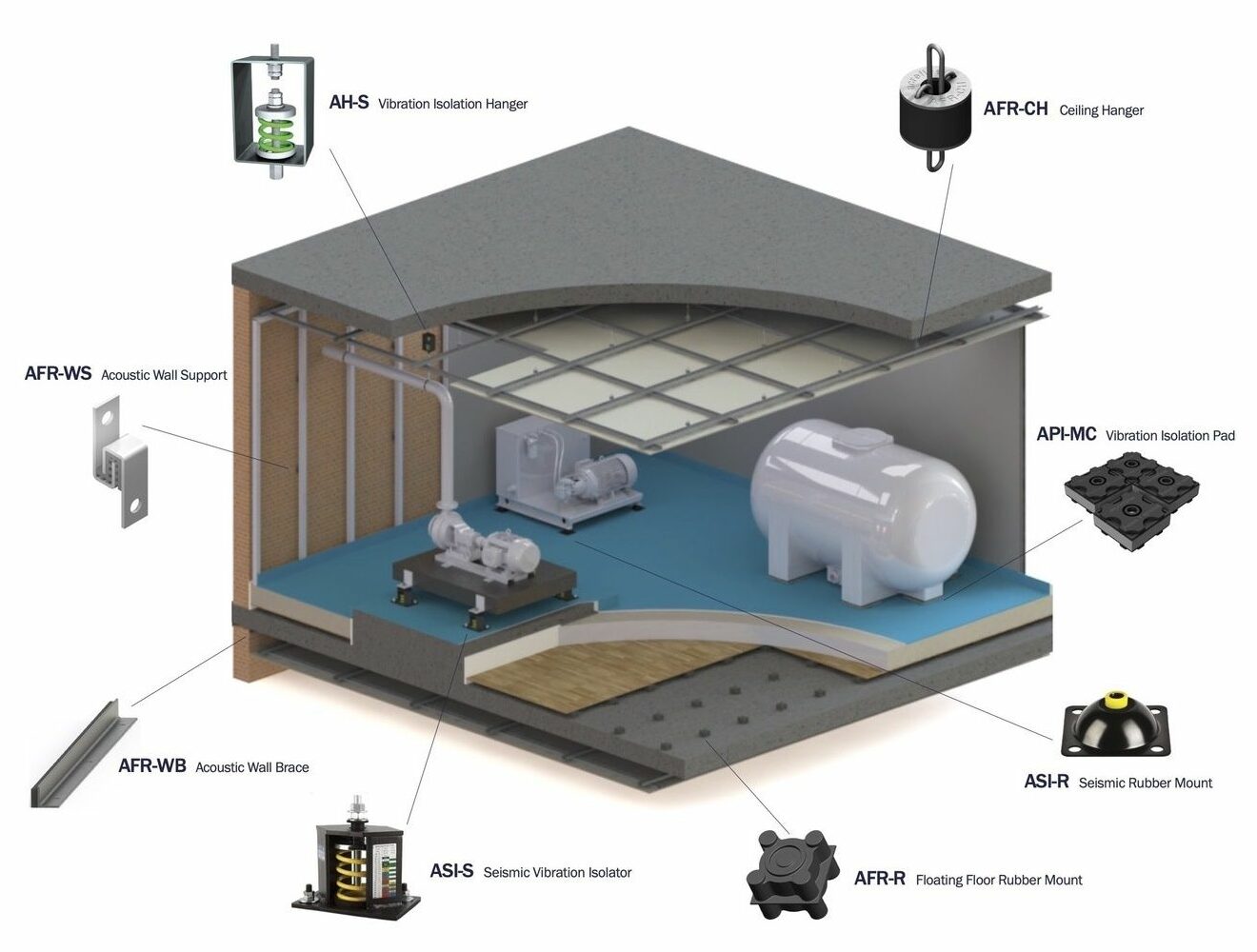
Acrefine’s noise and vibration control offerings for building services
- Vibration isolation calculations for individual equipment items
- Vibration isolation calculations for building services systems as a whole
- Layout drawings showing isolator locations and specifications
- Detailed drawings for procurement and installation
- BIM models of vibration isolation components for coordination
Beyond comfort: cost and lifespan — equipment that isn’t properly isolated experiences higher mechanical wear from transmitted vibration, which shortens service life and increases maintenance cost over time. Getting the isolation design right at the outset is the cheaper path across the life of the plant, not just at handover.
Standards
There’s no single mandatory code covering vibration isolation for MEP equipment — this is acoustic and comfort-driven design rather than life-safety design, so requirements are typically set by the project specification, building performance targets or client brief rather than a universal standard. Where a project references a specific acoustic or vibration criterion — an NR/NC noise rating, or a vibration velocity limit, for example — our isolation calculations are matched to that target, following the sound and vibration guidance published by ASHRAE, where our team participates in the Sound and Vibration technical committee TC 2.6.
Get in touch
Working on a project with a noise and vibration control requirement for MEP equipment? Contact us to talk through your scope — or browse our vibration isolation hardware if you’re sourcing components rather than a design service.