
Bahrain International Airport: Vibration Isolation and Seismic Restraint for a New Terminal
Restrained spring isolators, inertia bases built to our design and tens of thousands of seismic cable restraints for the building services of a 210,000 m² passenger terminal.
- LocationMuharraq, Bahrain
- BuildingAirport passenger terminal
- ProductsASI-V · API-C · seismic cable bracing · inertia base design
The new passenger terminal at Bahrain International Airport opened on 28 January 2021. It covers 210,000 m², has 24 departure gates and was built to handle 14 million passengers a year — a US$1.1 billion project at the centre of the kingdom’s airport modernisation.
A terminal of this size runs on its building services: chillers, pumps, air handling units and fans in its plant rooms, and kilometres of pipework, ductwork and cable trays above its ceilings. All of them had to be kept quiet in normal service and kept in place in an earthquake. That was our part of the project.
Our scope
Between 2017 and 2018 we worked for the terminal’s MEP contractors on more than ten separate orders, covering design, product supply and site supervision.
Design. Our engineers selected the vibration isolation and seismic restraint for each item of equipment, designed the concrete inertia bases for the pumps, and designed the seismic bracing for the pipework, ductwork and cable trays.
Products. We supplied the restrained spring isolators, anti-vibration pads and tens of thousands of seismic cable restraints that the design called for.
Site supervision. We supervised installation on site, so that what was built matched what was designed.
Restrained spring isolators for floor-mounted equipment
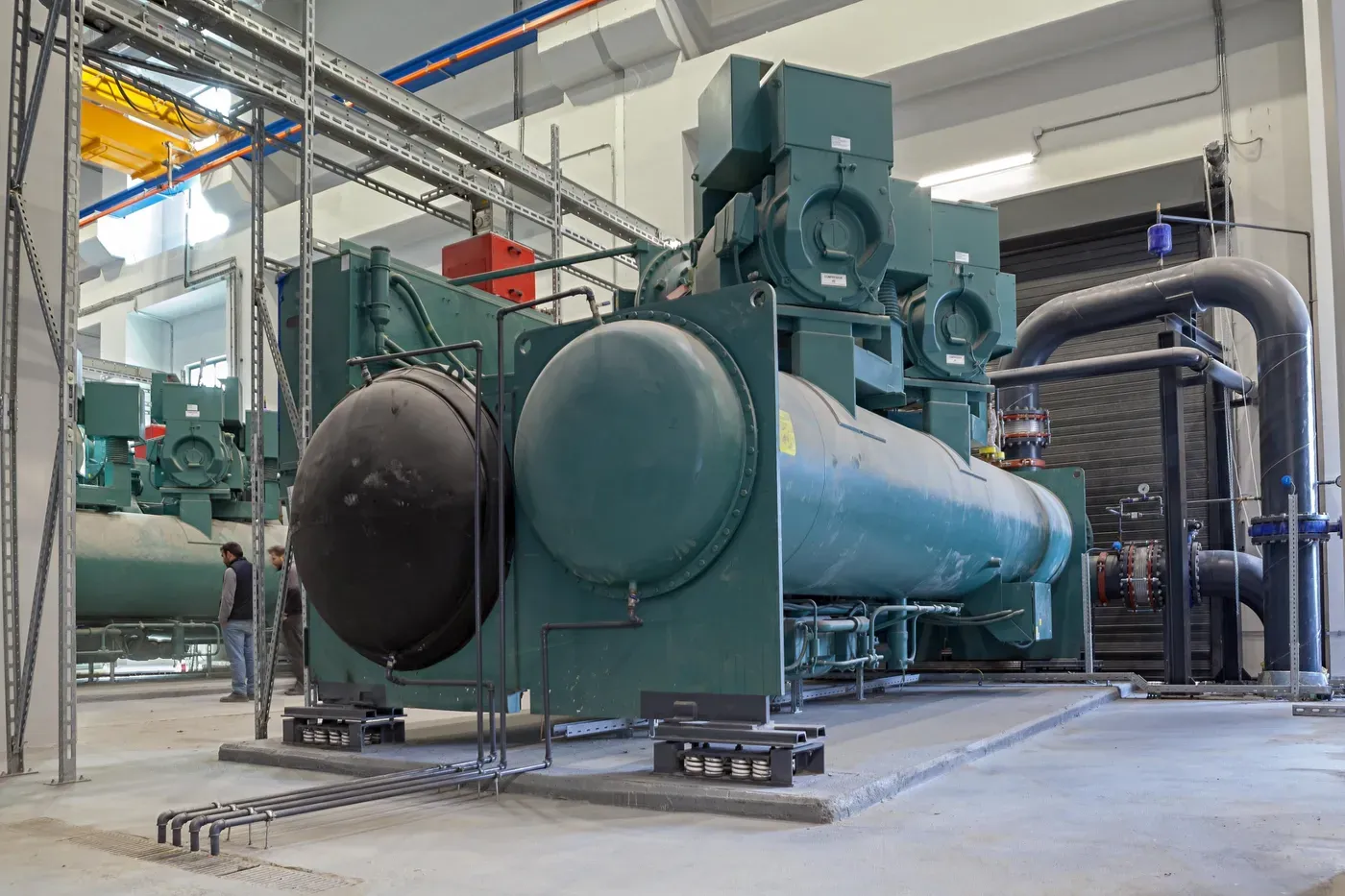
Pumps, chillers and other rotating equipment need spring isolators to keep their vibration out of the building. A spring isolator on its own, however, leaves the equipment free to move in an earthquake — and a pump that moves can tear its own pipework off.
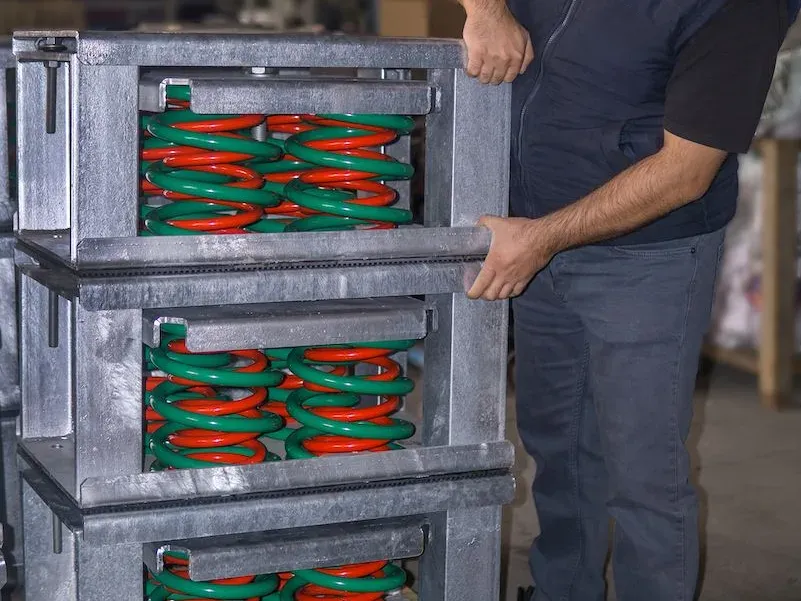
Most of the floor-mounted equipment in the terminal stands on our ASI-V restrained spring isolators. Each one combines vibration isolation and seismic restraint in a single mounting, so the equipment needs no separate snubbers. In normal service the spring carries the load and isolates the equipment. In an earthquake the restraint limits movement to 6 mm (1/4″) in any direction, and because there is no metal-to-metal contact inside the mounting, vibration does not short-circuit through the restraint. The equipment is resiliently mounted yet seismically restrained.
Lighter equipment that did not need springs went onto anti-vibration pads, most of them our API-C.
Inertia bases, designed by us and built on site
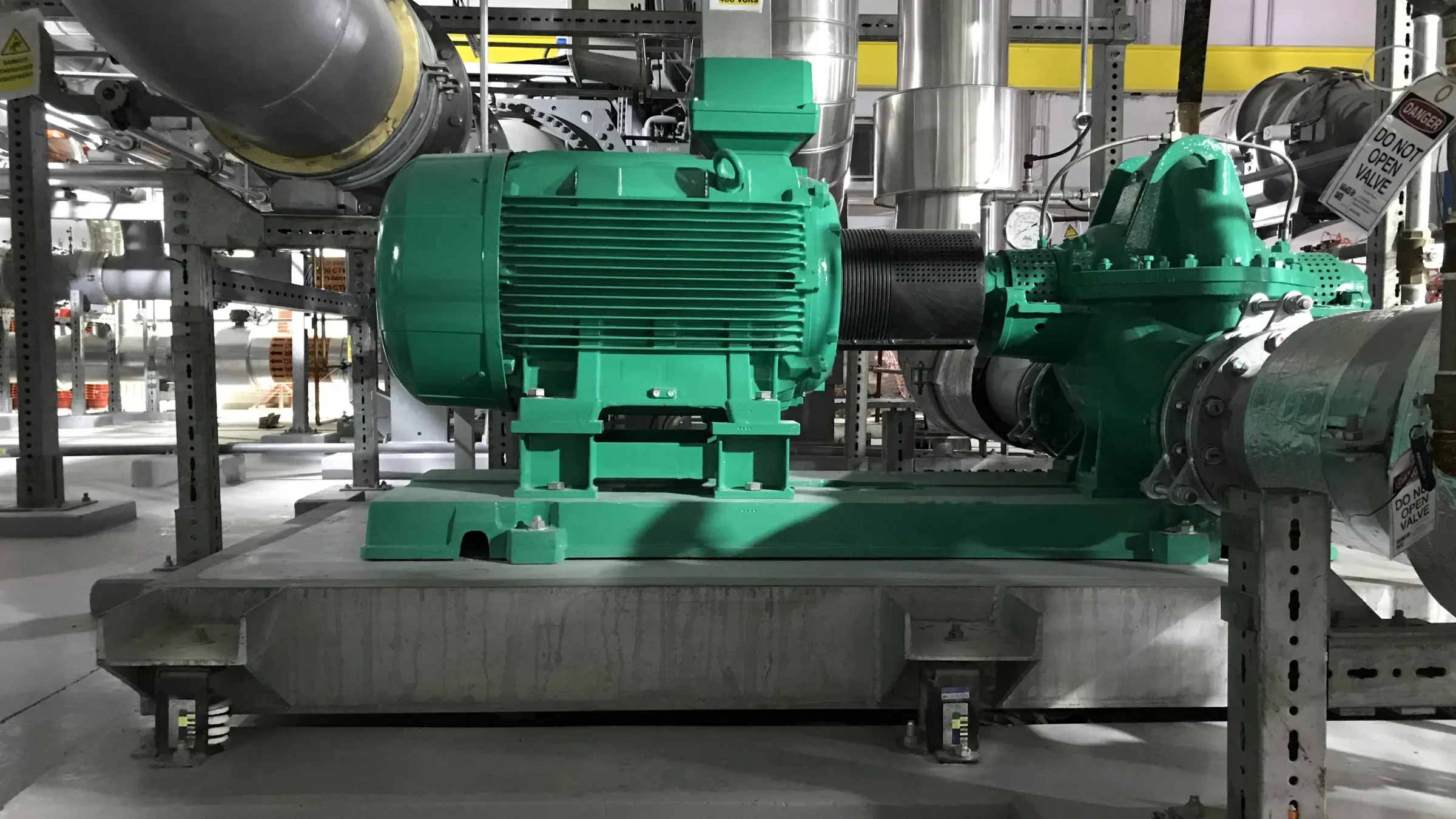
The terminal’s large pumps sit on concrete inertia bases, carried in turn by spring isolators. An inertia base adds mass below the pump: it lowers the centre of gravity, steadies the pump against the forces of its own pipework, and keeps the motor and pump in line as the springs move.
We designed each base to its pump — its size, its mass and the positions of the isolators beneath it — and the bases were cast on site to our drawings. Building them on site avoids shipping tonnes of concrete, and the drawings make sure that what is cast is what was calculated.
Seismic cable bracing at terminal scale
Above the ceilings of a terminal this size, services run for kilometres. Every run of pipework, ductwork and cable tray has to stay on its supports in an earthquake, and none of it may swing into its neighbour.
We designed the bracing for these services and supplied tens of thousands of seismic cable restraints. Cable bracing is light, quick to install and easy to adjust on site around other services, which matters in ceiling voids shared by several trades. Each brace was placed to resist transverse and longitudinal movement, with spacing set by the weight of the service and the strength of its supports.
Isolation and restraint, designed together
Vibration isolation and seismic restraint pull in opposite directions: one lets equipment move, the other stops it. Designed separately, they tend to undo each other — a restraint that touches in normal service carries vibration straight into the structure, and an isolator with no restraint lets the equipment walk in an earthquake.
At Bahrain both were selected together, for each item of equipment, by the same engineers. That is the approach we take on every project, from airport terminals to data centres.
Products used on this project
Products used on this project
More projects
Where else our work is installed

Related engineering services

Planning a project like this?
Describe the building and the equipment. We will tell you what it takes.