
Istanbul Airport: Seismic Restraint and Vibration Isolation at Scale
Design, supply and site supervision of the vibration isolation and seismic restraint for the building services of the whole airport, from heavy-duty isolators under the chillers to tens of thousands of seismic cable braces.
- LocationIstanbul, Türkiye
- BuildingAirport: terminal and supporting buildings
- ProductsASI-T and ASI-T12 heavy-duty spring isolators · ASI-V restrained spring isolators · ASB-GRP seismic cable bracing · isolation hangers · anti-vibration pads
Istanbul Airport opened on 29 October 2018, and by 6 April 2019 every scheduled passenger flight had moved there from Atatürk Airport. Its main terminal alone covers 1.44 million m², one of the largest terminal buildings in the world, in a city that lies close to the North Anatolian Fault.
An airport of this size depends on its building services: chillers and pumps in its plant rooms, air handling units and fans, and pipework, ductwork and cable trays running through every building. In normal service that equipment must not pass its vibration into the structure. In an earthquake it must stay where it is, so that the airport can keep working afterwards.
A full package, for the whole airport
We delivered the vibration isolation and seismic restraint for the building services as one package, across the airport rather than a single building.
Design. Our engineers selected the isolation and restraint for each item of equipment and designed the seismic bracing for the pipework, ductwork and cable trays.
Products. We supplied the isolators, hangers, pads and seismic bracing that the design called for.
Site supervision. We supervised installation on site, so that what was built matched what was designed.
Heavy-duty isolators under the chillers
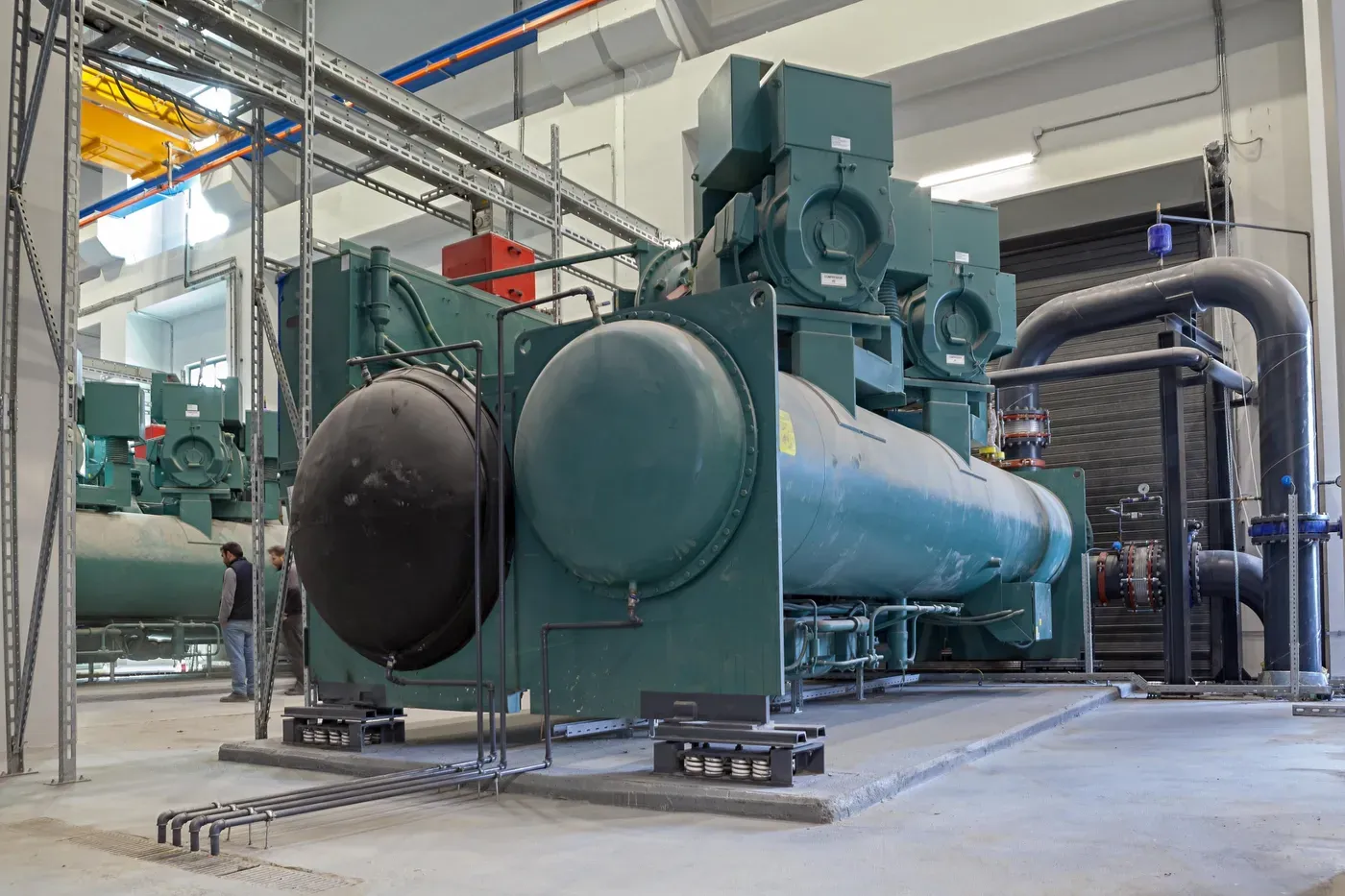
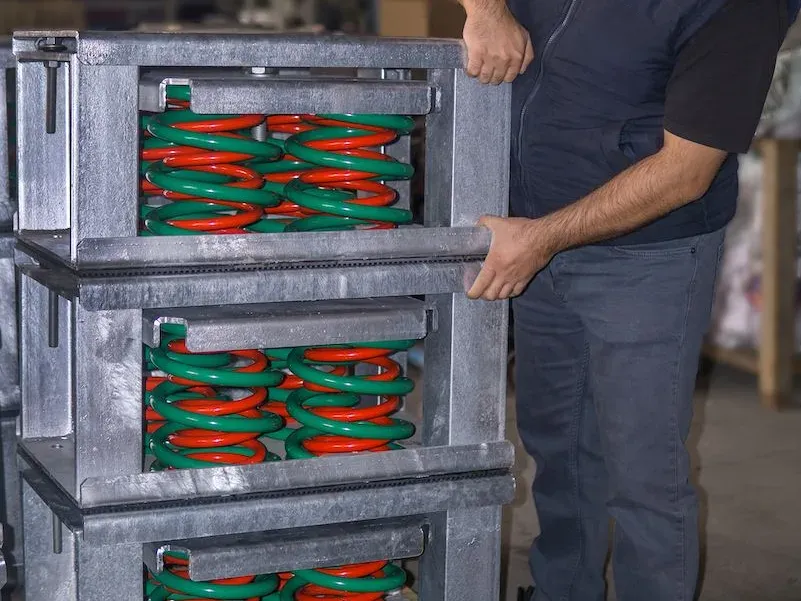
The airport’s chillers are among the heaviest items of equipment in any building. They stand on our ASI-T heavy-duty spring isolators, built for this project as the ASI-T12: a twelve-spring version, beyond the standard range.
An ASI-T carries its load on colour-coded springs under a steel top plate, inside a welded steel housing with restraint points on every axis, so the chiller cannot walk or rock on its springs. Where the top plate is held to the housing, the studs pass through grommets with rubber washers above and below. There is no metal-to-metal contact, so the restraint never short-circuits the isolation. The springs can be replaced on site without removing the housing.
See the chiller installation in 3D ↗
Restrained spring isolators for the rest of the equipment
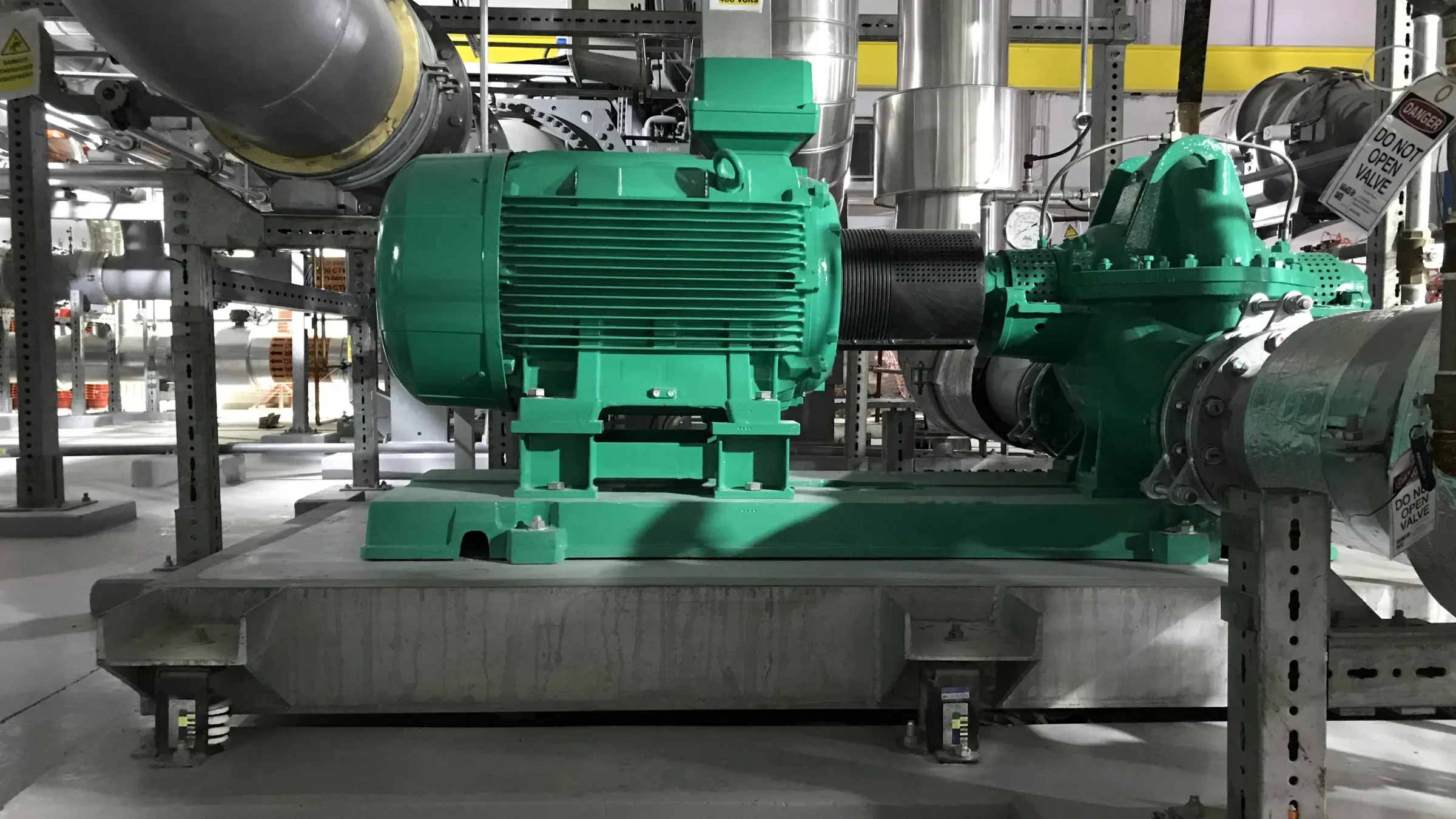
Most of the other floor-mounted equipment, from pumps to air handling units, stands on our ASI-V restrained spring isolators. Each ASI-V does two jobs in one mounting. The spring isolates the equipment in normal service; in an earthquake the restraint stops it moving more than 6 mm (¼″) in any direction. No separate snubbers are needed, and the equipment is resiliently mounted yet seismically restrained.
Hangers and pads
Not everything stands on the floor. Suspended equipment and the services near it hang from our vibration isolation hangers, spring or rubber as each load required. Lighter equipment that did not need springs went onto anti-vibration pads.
Tens of thousands of seismic cable braces
Above the ceilings and through the service corridors, every run of pipework, ductwork and cable tray had to stay on its supports in an earthquake. We designed the bracing and supplied tens of thousands of our ASB-GRP seismic cable bracing kits.
Each kit is a steel cable with a bracket fitted at one end and a self-locking grip at the other, so the cable is cut to length and tensioned on site without special tools. The kits are colour-coded by strength, which makes inspection quick on a site of this size. Installed with a small slack, a cable brace takes no load in normal service and engages only when the service moves in an earthquake, so it can restrain isolated services as well as rigidly hung ones.
Why scale changes the job
On a single building, a mistake in a bracing detail is one mistake. On an airport, the same detail is repeated thousands of times, and so is the mistake. At this scale the value lies less in any one calculation than in the consistency between them: the same design rules, the same details and the same team from the first drawing to the last inspection on site.
That is why we took Istanbul Airport on as a full package rather than a supply order, and why we work the same way on every project, from airports to data centres.
Products used on this project
Products used on this project
More projects
Where else our work is installed

Related engineering services

Planning a project like this?
Describe the building and the equipment. We will tell you what it takes.