
Nanyang Technological University: Heavy-Duty Isolators for the Campus Chiller Plants
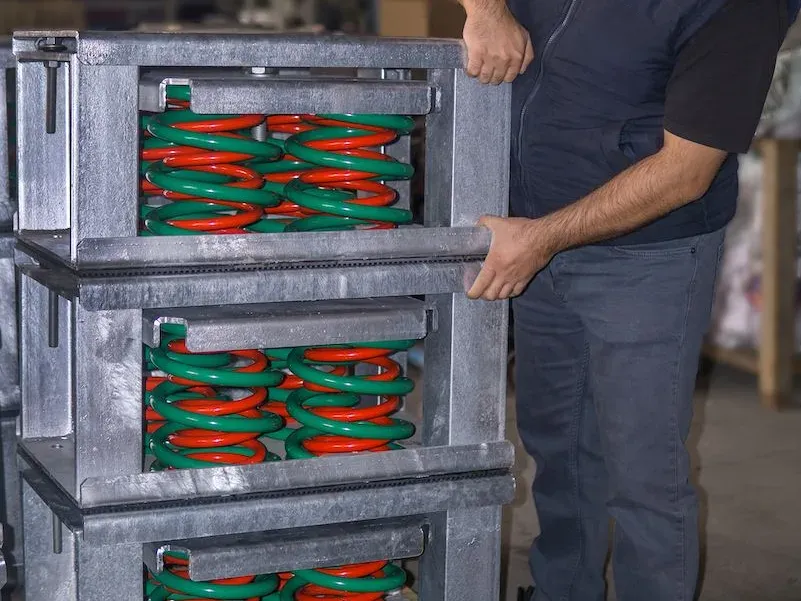
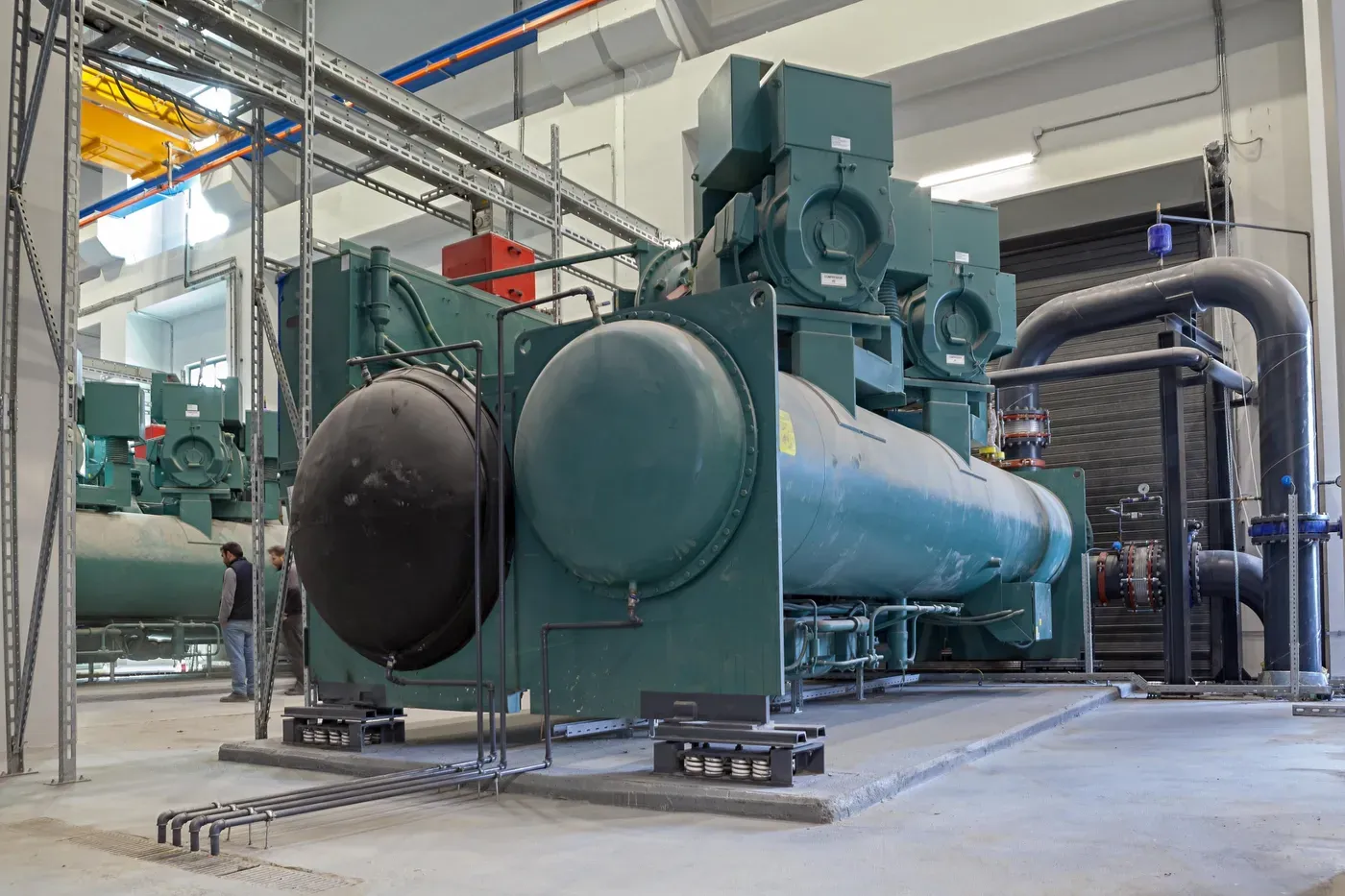
Hot-dip galvanised ASI-T4 heavy-duty spring isolators, with springs designed by us for the 100 mm (4″) deflection the specification called for, under the chillers of a university campus.
- LocationSingapore
- BuildingUniversity campus chiller plants
- ProductsASI-T4 heavy-duty spring isolators, 100 mm (4″) deflection, hot-dip galvanised · API-S pads
Nanyang Technological University is one of Singapore’s two largest universities, on a campus in the west of the island. Its buildings are cooled by chiller plants: large chillers, running for long hours in a hot, humid climate, close to lecture theatres, laboratories and offices where noise and vibration are not welcome.
For these plants we supplied heavy-duty spring isolators to the project’s contractor, the Japanese company Kurihara Kogyo. Many chillers were involved, across the campus plants.
ASI-T4 heavy-duty spring isolators
The isolators are our ASI-T4: the four-spring version of the ASI-T, our heavy-duty spring isolator in a welded steel housing.
Each ASI-T4 carries its share of the chiller on colour-coded springs, nested in pairs — an outer and an inner coil working together — under a steel top plate. The welded housing has restraint points on every axis, so the chiller cannot walk or rock on its springs. Where the top plate is held to the housing, the studs pass through grommets with rubber washers above and below: there is no metal-to-metal contact, so the restraint never short-circuits the isolation. The chiller is resiliently mounted and held in place. The springs can be replaced on site without removing the housing.
As standard, ASI-T isolators come with 25 mm or 50 mm of deflection. The NTU specification called for 100 mm (4″), so the isolators were made to order, with springs we designed to reach that deflection under each chiller’s load.
Why 100 mm (4″) of deflection
A spring isolator works by being much softer than the vibration it has to stop. The softer the spring, the lower its natural frequency: a spring compressed by 25 mm under its load has a natural frequency of about 3.2 Hz; one compressed by 100 mm, about 1.6 Hz. The further that natural frequency sits below the frequencies the equipment produces, the less vibration reaches the building.
High deflection matters most in three situations, and chiller plants often meet all of them:
- Long-span or upper floors. A floor is itself a spring. When a heavy chiller stands on a slab that deflects, the isolator has to be several times softer than the floor; otherwise floor and springs move together and vibration passes straight through.
- Low-frequency vibration. Slower-running equipment produces vibration at frequencies a stiffer spring cannot isolate.
- Sensitive neighbours. Where a chiller plant sits near rooms that need to be quiet, small amounts of transmitted vibration become audible noise in the structure.
A rubber pad under every isolator
A steel spring is excellent at low frequencies, but at high frequencies the coil itself can ring and pass vibration through its own body — the noise a spring isolator can let through on its own. The NTU specification therefore called for a second stage: every ASI-T4 stands on a full-size API-S ribbed rubber pad under its base plate. The spring handles the low frequencies, and the rubber stops the high-frequency ringing before it reaches the slab.
Hot-dip galvanised for the climate
Singapore is hot and humid all year round. Plant rooms are damp, and painted steel corrodes. Every ASI-T4 for NTU was hot-dip galvanised: the zinc coating covers the housing inside and out, including edges and welds where paint is thinnest, and protects the steel for the life of the plant.
A galvanised housing is only as durable as the hardware that holds it together. Thin electroplated zinc on a stud or nut wears away long before the galvanising around it, and the fasteners become the first part to rust. The studs, nuts and washers were therefore Geomet-coated: a zinc-flake coating with a corrosion life to match the housing, and applied without the electrolytic process that can embrittle high-strength steel.
Heavy-duty, built to the project
Standard ranges cover most equipment. Large chillers on long spans, in a demanding climate, sit outside them. For those we size the isolator to the equipment — load, deflection, housing and finish — and supply it ourselves. NTU was one of many such projects. See our heavy-duty and tailor-made products.
Products used on this project
Products used on this project
More projects
Where else our work is installed

Related engineering services

Planning a project like this?
Describe the building and the equipment. We will tell you what it takes.